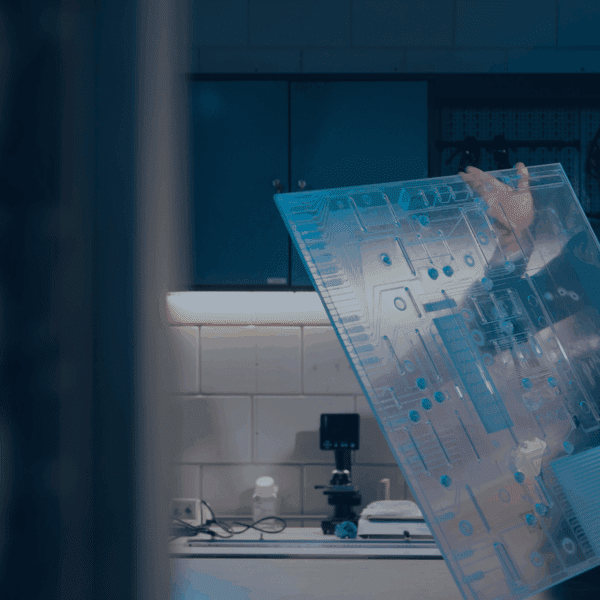
Through the HDT Bio-led consortium, we are contributing RiboFlux™ to a manufacturing system designed for personalized RNA medicines. A central part of the work is connecting chip-based production with quality testing throughout the workflow.
For a medicine designed for one patient, manufacturing and quality testing must work with the same small batch. Every sample taken for analysis uses material, every transfer needs to be tracked, and every result must remain connected to the batch it represents.
These considerations shape our contribution to the ARPA-H Genetic Medicines and Individualized Manufacturing for Everyone (GIVE) program. Alongside our consortium partners, we are developing an integrated approach to producing and testing personalized RNA medicines at or near the point-of-care.
A repeatable workflow for patient-specific RNA
Personalized RNA manufacturing involves producing many distinct batches, potentially with a different sequence for each patient. That makes a standardized manufacturing route particularly valuable: the system needs to accommodate product variation while retaining control over processing, sampling and documentation.
The consortium is developing a compact platform connecting automated DNA synthesis, RNA production, formulation, purification, and fill and finish. Manufacturing and quality-control functions are intended to operate within a controlled enclosure, supported by system software and electronic batch records.
RiboFlux contributes the chip-based, automated RNA manufacturing technology within this architecture. Our work connects that production capability with the upstream DNA input and the downstream operations needed to obtain a formulated, tested product.
The technical task is to make these components function as a coordinated workflow, with defined interfaces for material transfer, sampling and data.
Designing quality control into the manufacturing workflow
For decentralized manufacturing to become practical, quality testing needs to fit the production setting. Moving RNA production closer to patients would offer limited operational benefit if every batch still depended on a fragmented analytical workflow elsewhere.
Therefore, we will include multiple quality-control assays integrated onto the chip, with samples taken at defined stages of processing.
This would allow the system to build a record of the batch as it moves through manufacturing. Depending on the assay and sampling point, those measurements could support process monitoring, development decisions or assessment of the finished product.
Three considerations guide this approach.
Maintaining traceability. Each sample and analytical result needs to remain linked to its source batch and processing stage. Integrating sampling and testing within the system reduces separate handling steps and supports a documented chain of custody.
Preserving material. Sample consumption matters when manufacturing small, individualized batches. Microfluidic assay formats offer an opportunity to reduce the material required for testing.
Following quality through the process. Measurements at different stages can provide information that a final sample alone cannot. Connecting those results may help identify where a change occurred and support a better understanding of the manufacturing workflow.
Bringing quality control onto the chip
Integrating quality control into a microfluidic manufacturing system means designing sample preparation, reagent handling and detection to work directly with the production workflow.
Within the project, we will develop microfluidic assay formats and define where and how often to sample during manufacturing. Sensitivity and reliability will guide the design, alongside practical integration into the chip.
Our ambition is to bring all routine release testing onto the chip, connecting production and quality assessment within one automated workflow. Together, these capabilities are designed to support routine manufacturing and the deeper analytical work needed to develop and understand the process.
Connecting each physical batch with its digital record
Reliable automation depends on a clear connection between the material moving through the system and the data recorded along the way.
The platform is being designed to link manufacturing operations, sampling events and analytical results to the corresponding batch. Electronic batch records will bring this information together, providing a traceable history of how each product was manufactured and tested.
For manufacturing across multiple locations, this digital record is essential. A standardized approach to capturing process and quality data will support consistent documentation and batch review across sites.
Building and evaluating the integrated system
The first project phase focuses on engineering design and feasibility demonstrations. For our chip-based manufacturing and analytical workflow, this means defining quality requirements, developing sampling strategies and translating laboratory assays into microfluidic formats.
A next phase is planned to build and deploy the integrated system at Houston Methodist Research Institute. Three demonstration products will be used to evaluate manufacturing and quality-control performance across different RNA formats and applications:
- A personalized self-amplifying RNA neoantigen immunotherapy formulated with HDT Bio’s LION™ delivery system.
- A CD19/BCMA CAR-T mRNA product for ex vivo cell therapy.
- A circular RNA gene therapy product.
These products provide different RNA formats and applications through which to assess the proposed manufacturing and testing approach.
Delivering this system draws on complementary expertise across the consortium:
HDT Bio leads the project and contributes RNA construct design and LION formulation expertise.
ELEGEN contributes automated DNA synthesis.
RiboPro contributes automated, chip-based RNA manufacturing through RiboFlux.
Triple Ring Technologies contributes system software.
The University of Queensland’s BASE facility contributes analytical quality control.
Houston Methodist Research Institute contributes system integration and clinical translation.
What this means for RiboPro
At RiboPro, we have built RiboFlux with an ambition to have a standardized, automated manufacturing approach: a closed, automated, end-to-end manufacturing platform designed to produce formulated RNA across program stages and scales. This project takes that approach into personalized medicine, where each patient-specific batch needs a controlled production workflow and a traceable quality record.
By connecting chip-based RNA production with integrated analytical capabilities, we are working toward a system that can manufacture and test different RNA medicines through the same repeatable workflow. That is a practical foundation for bringing production closer to patients across multiple locations.
Read more about ARPA-H’s GIVE program and the selected teams.