Authors
Judith Del Campo, Séverine Valsesia, Elsa Nikly, Roberto Ruiu, Antonella Iacoviello, Elena Quaglino, Federica Cavallo, Dalil Hannani, Emilie Boucher, Florence Nicolas, Alexandre Le Vert, Francesco Doro
Highlights
Tumours with low mutational burden often do not generate a strong enough T cell response. Here, the authors investigated OSIVAX’s oligoDOMTM which is a self-assembling antigen-fusion sequence designed to enhance T cell priming and immune activation. OligoDOMTM was incorporated into an mRNA sequence, where it was fused with four short epitope strings. Although the study evaluated oligoDOM™-fused mRNA constructs across several tumour-antigen models, the data highlighted here focus on the RiboPro LNP-formulated HPV E7-oligoDOM mRNA used in the TC-1 prophylactic tumour model. The constructs were optimized using our proprietary RiboStealthTM algorithm for sequence optimization and de-immunization and were produced with our RiboPerfectTM T7 RNA polymerase for reduced levels of dsRNA. Six-week-old C57BL/6 mice received two intramuscular immunizations three weeks apart at either 0.5 or 2 µg of the HPV E7 antigen per mouse. This was followed by TC-1 tumour engraftment one week after the final immunization. Here, oligoDOM-fused mRNA constructs generated stronger antigen (E7)-specific IFNγ T-cell responses and were associated with significantly reduced TC-1 tumour growth when compared to control constructs. These results support the suitability of RiboPro LNP-formulated mRNA for delivering immunogenic cancer-vaccine constructs. A results snippet showcasing the efficacy of RiboPro LNP-delivered HPV E7-oligoDOM mRNA is illustrated in Figure 1.
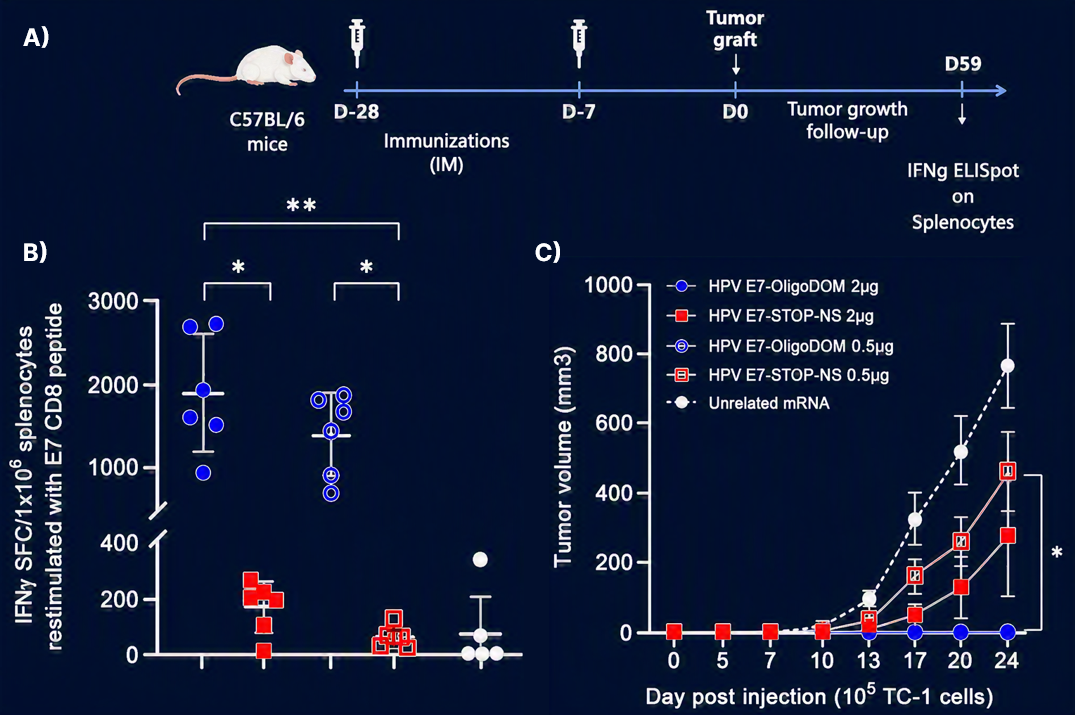
Figure 1: (A) Schematic illustrating the prophylactic treatment protocol of C57BL/6 mice. (B) IFNγ ELISpot as measured in splenocytes following treatment with OligoDOM mRNA encapsulated in RiboPro LNPs to induce HPV E7 antigen presentation in TC-1 tumour cells. (C) Tumour volume (mm3) following treatment with OligoDOM mRNA encapsulated in RiboPro LNPs to induce antigen presentation in TC-1 tumour cells. STOP-NS: non-translated sequence; SFC: Spot forming cells.
Source: Adapted from Article under the CC BY 4.0 license. Visual design and formatting modified by RIBOPRO.
DOI
https://doi.org/10.3389/fimmu.2025.1549112
Journal: Frontiers in Immunology
PMID: 40160825
PMCID: PMC11951937
Abstract
Background: Neoepitopes derived (0) from tumors are attractive cancer immunotherapy targets, especially when combined with immune checkpoint inhibitors (CPIs). Vaccines using lipid nanoparticle (LNP)-encapsulated mRNA to deliver neoepitopes have shown encouraging results in patients and animal models, due to T cell-dependent responses. However, a low mutational burden is often a predictor of poor CPI response: the immune response against the few available mutations can be insufficient. An enhanced response to these few mutations could increase CPI efficacy. Here, we investigate the potential of oligoDOM™, a self-assembling sequence, to improve neoepitope immunogenicity and antitumor efficacy in murine cancer models.
Methods: LNP-formulated mRNA constructs encoding short epitope strings fused with oligoDOM™ were tested. Immune responses in mice were compared between constructs with oligoDOM™ and their controls. Specific T-cell responses against four tumor models (MC38, CT26, TC-1, B16-OVA) were measured using ELISpot in naïve mice. Two models (TC-1 and B16-OVA) were further selected for tumor growth efficacy testing.
Results: LNP-formulated neoepitope-oligoDOM™ mRNA constructs induced a significantly superior immune response as compared with the control groups in four neoantigens tested. This increased specific immunogenicity is linked to antitumor growth effects in murine syngeneic cancer models such as the B16-OVA and TC-1. The induced T-cell immune response significantly correlated with tumor growth rate reduction.
Discussion: Combining oligoDOM™ and LNP-mRNA technologies offers a versatile platform that allows for efficient short neoepitope strings delivery. This approach represents a feasible, potentially effective strategy for personalized cancer immunotherapy.